

Botulinum treatments
We offer botulinum toxin treatments for migraine and teeth grinding(bruxism) and for aesthetic purposes.
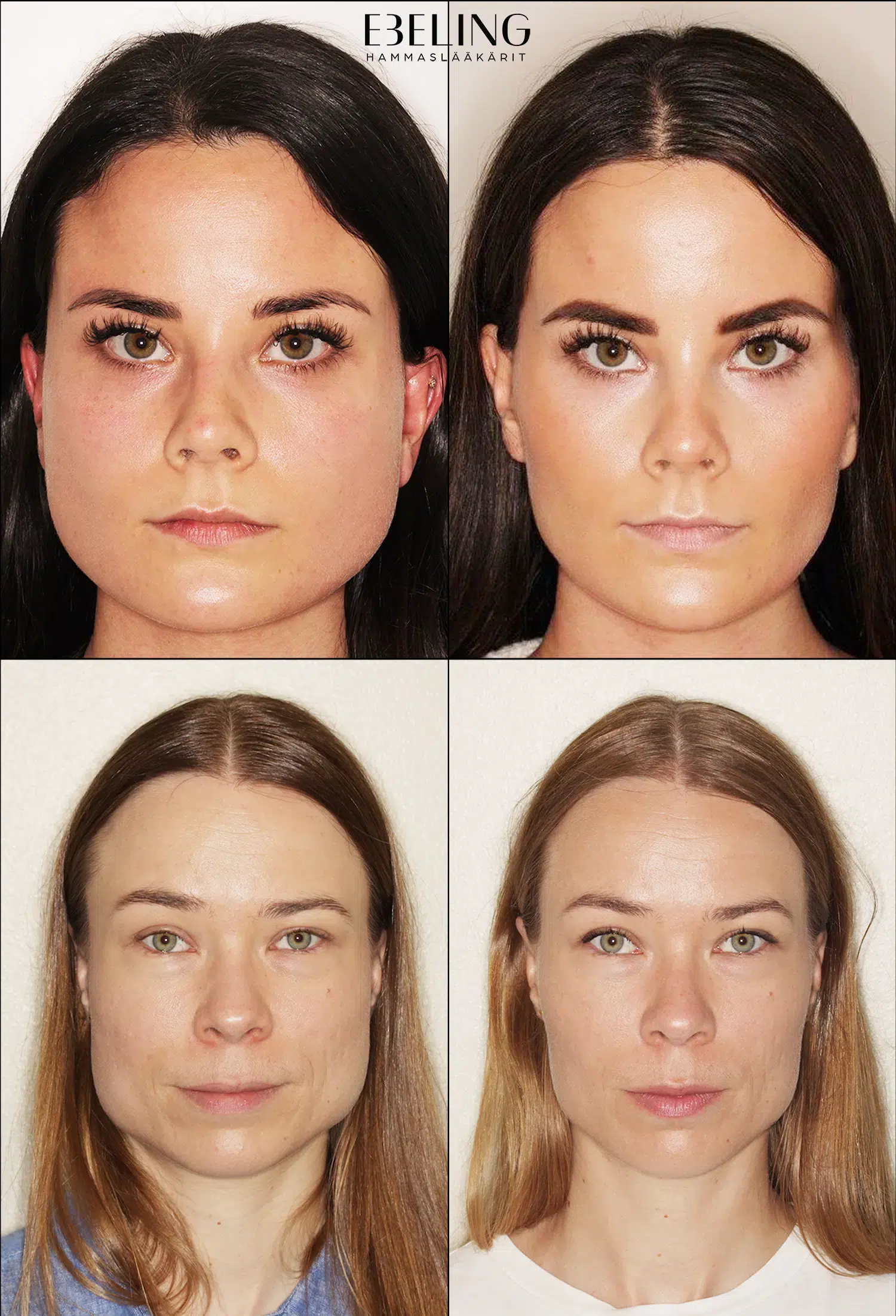
Botulinum toxin, when injected into a muscle, prevents excessive muscle tension, usually for 3-6 months. For people with severe teeth grinding, the jaw relaxes and headaches are reduced. If the jaw and/or temporal muscles have grown as a result of constant overstraining, the shape of the face will also begin to return within a few months (see example pictures below). It is advisable to discuss the suitability of botulinum treatment with your dentist if primary treatments such as bite splint therapy have not provided sufficient relief.
At Ebeling Dentists, botulinum toxin treatment for bruxism includes follow-up injections during a follow-up visit approximately 3 weeks later, if necessary, should symptoms not have improved sufficiently. Similarly, aesthetic botulinum toxin treatments include a follow-up visit if the initial injections have not achieved the desired effect. Everyone reacts to the medication individually, so it is advisable to start treatment with cautious doses, especially during the first treatment session.
In aesthetic treatments, wrinkles are temporarily smoothed by paralysing the small muscles that constrict the skin.
Botulinum treatment is well researched and very safe. Only pregnancy, breast-feeding and muscle degeneration are contraindications.
Prices of botulinum treatments
Botox for the treatment of teeth grinding: 466 € (with Dysport) or 516 € (with Botox).
Additional areas, such as migraine treatment or cosmetic procedures, during the same visit: 109 € / area.
Cosmetic botulinum toxin treatment: 261 €.
Additional areas on the same visit: 109 € / area.
The above prices include the price of the medicine (botulinum toxin).
The price of treatment includes additional injections during follow-up visits, if necessary.
Don't forget to check out the services of Ebeling Beauty!

Experiences with botulinum treatments
Frequently asked questions about botulinum toxin treatment for bruxism and aesthetic purposes
Therapeutic treatment (such as treating bruxism with botulinum toxin) aims to reduce muscle hyperactivity and symptoms such as pain, headaches, and tooth wear. Aesthetic treatment aims to smooth out lines, for example on the forehead or around the eyes, by relaxing the small muscles responsible for facial expressions. In the treatment of bruxism, the focus is on the stronger chewing muscles. Aesthetic treatment can often help with headaches as the overactive facial muscles relax.
Botulinum toxin treatment reduces skin wrinkling, softening or smoothing out lines on the skin's surface and slowing down the formation of new ones. At some point in the aging process, even botulinum toxin will no longer be able to smooth out all lines.
Possible side effects are mild, mainly cosmetic and temporary. There may be slight tenderness at the injection site or a temporary feeling of weakness in the muscle. A temporary bruise may sometimes form around the injection site. If the dosage or injection sites are not correct, facial expressions may be temporarily asymmetrical. Possible variations in muscle anatomy may also lead to an undesirable aesthetic result.
Many people continue to benefit from bite splints because they protect the teeth. Botulinum toxin treatment and bite splints complement each other: botulinum toxin reduces muscle tension and the splint protects the teeth from wear.
The interval between treatments varies from 3 months upwards. In some cases, one or a few treatments may break the cycle of tension, eliminating the need for regular treatment. Most patients repeat botulinum toxin treatment about twice a year. The recurrence of bruxism and symptoms is individual, and often the patient himself is best able to assess when he needs repeat treatment with botulinum toxin.
Botulinum toxin relaxes the chewing muscles by preventing excessive muscle tension. When the jaws cannot clench as strongly, grinding, tension, and pain in the chewing muscles are reduced. The effect of the treatment usually lasts for 3–6 months, after which the treatment can be repeated if necessary. Even though the medication is no longer effective after 6 months, the situation does not usually return to being as bad as it was before treatment, because the muscles that have been at rest have weakened and shrunk. In addition, it is possible that the patient will unlearn the habit of clenching.
Botulinum toxin treatment is particularly suitable for patients whose chewing muscles are constantly tense and whose bruxism causes headaches, jaw stiffness, or tooth wear. In addition, bruxism can aggravate migraines and cause symptoms such as ringing in the ears or noise. The treatment is often a good option when bite splints or other primary treatments have not provided sufficient relief.
The injection usually feels like a small pinch, and the entire procedure takes 5–15 minutes. In most cases, no recovery time is needed, and you can return to your daily routine immediately after the treatment, as long as you do not lie on your face for a few hours after the treatment. This means that you should not book a massage for the same day, for example. You should also not apply makeup until the injection sites have healed, which takes a few hours. You may experience slight soreness for 1–2 days.
The effect usually begins within 3–7 days, and the final effect is visible after about two weeks. The masticatory muscles gradually relax, alleviating nighttime grinding and jaw tension. The size of the masticatory muscles and bite force also gradually decrease as the excessive strain is reduced.
Yes — especially when the shape of the face has changed due to excessive strain on the chewing muscles. Overdeveloped jaw and temple muscles can shrink within a few months, restoring a more natural shape to the face. Sometimes the difference is only noticeable after several treatment sessions.
Yes. Botulinum toxin has been extensively researched and, when administered correctly, is a very safe form of treatment. However, treatment is not recommended during pregnancy or breastfeeding, or for people with diseases that cause muscle wasting.
For some patients, botulinum toxin can relieve migraines or headaches, especially if they are related to constant tension in the masticatory muscles. Treating the masticatory muscles can also reduce sinus pain and facial tension.