

Botox Treatment for Bruxism or Migraines
We offer Botox treatments for migraines and teeth grinding (bruxism), as well as for cosmetic purposes. Although “Botox” has become almost a generic term, it is actually just one brand name. Instead of Botox, other botulinum toxin brands, such as Dysport, can also be used.
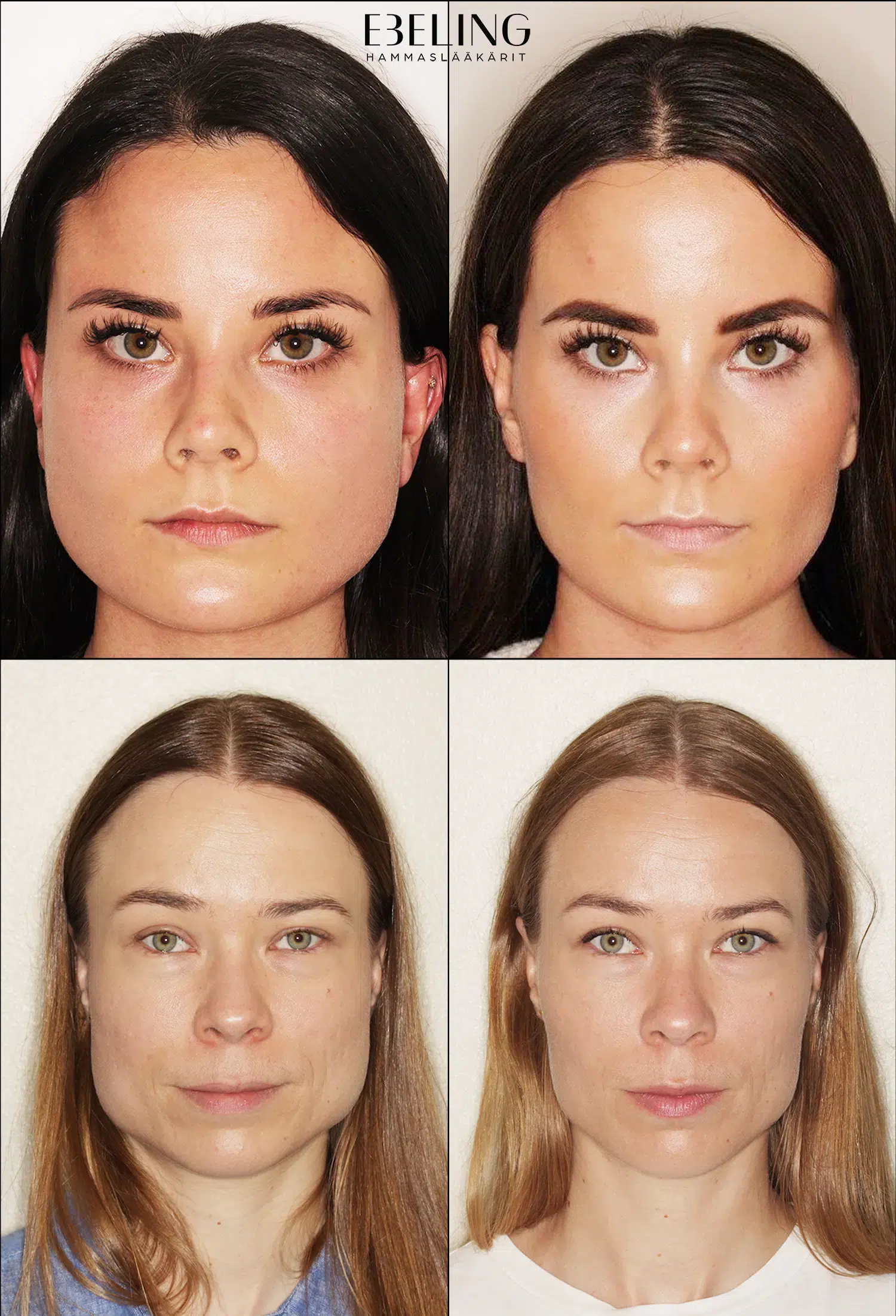
When injected into a muscle, botulinum toxin treatment prevents muscle contraction, typically for 3 to 6 months. For people who clench their teeth tightly, the jaw relaxes and headaches are reduced. If the jaw and/or temporal muscles have grown as a result of constant overuse, the shape of the face also begins to return to normal within a few months (see example photos).
In aesthetic treatments, wrinkles are temporarily smoothed by paralysing the small muscles that constrict the skin.
Botulinum treatment is well researched and very safe. Only pregnancy, breast-feeding and muscle degeneration are contraindications.
Botox for the treatment of teeth grinding: 466 € (with Dysport) or 516 € (with Botox).
Additional areas treated during the same visit as part of medical care (e.g., for cosmetic purposes or migraine treatment): 109 € / area.
Cosmetic botulinum toxin treatment: 261 €.
Additional areas on the same visit: 109 € / area.
Yo. prices include the price of the medicine (botulinum).
Be sure to check out Ebeling Beauty's services as well!

Experiences with botulinum treatments
Frequently Asked Questions About Botox Treatment for Bruxism and Cosmetic Purposes
Many people still benefit from a mouthguard because it protects their teeth. Botox treatment and a mouthguard complement each other: Botox reduces muscle tension, and the mouthguard protects the teeth from wear.
The interval between treatments varies, from 3 months upwards. For some patients, a single session or a few sessions may break the cycle of tension, eliminating the need for regular treatment. Most patients undergo Botox treatment about twice a year. The recurrence of bruxism and symptoms varies from person to person, and often the patient is best able to assess when they need a follow-up treatment with botulinum toxin.
Botox (botulinum toxin) relaxes the jaw muscles by preventing them from becoming overly tense. When the jaws cannot clench as tightly, grinding and pain in the jaw muscles decrease. The effects of the treatment usually last 3–6 months, after which the treatment can be repeated if necessary. Although the medication no longer works after more than 6 months, the situation usually does not immediately return to being as bad as it was before treatment, because the muscles that have been at rest have had time to weaken and shrink. Additionally, it is possible that the habit of clenching may be unlearned.
Botox treatment is particularly suitable for patients whose jaw muscles are constantly tense and whose bruxism causes headaches, jaw stiffness, or tooth wear. In addition, bruxism can exacerbate migraines and cause symptoms such as ringing or buzzing in the ears. The treatment is often a good option when a bite splint or other primary treatments have not provided sufficient relief.
The injection usually feels like a small pinch, and the entire procedure takes 5–15 minutes. In most cases, no recovery time is needed, and you can return to your daily routine immediately after the treatment, as long as you do not lie on your face for a few hours after the treatment. This means that you should not book a massage for the same day, for example. You should also not apply makeup until the injection sites have healed, which takes a few hours. You may experience slight soreness for 1–2 days.
The effect usually begins within 3–7 days, and the final effect is visible after about two weeks. The masticatory muscles gradually relax, alleviating nighttime grinding and jaw tension. The size of the masticatory muscles and bite force also gradually decrease as the excessive strain is reduced.
Yes—but only in a positive way, specifically when the shape of the face has changed due to excessive strain on the chewing muscles. Overdeveloped jaw and temporal muscles can shrink over the course of a few months, restoring a more natural facial shape. Sometimes the difference isn’t noticeable until after several treatment sessions.
Yes. Botox has been extensively studied and, when administered correctly, is a very safe treatment. However, the treatment is not recommended during pregnancy or while breastfeeding, nor for people with conditions that cause muscle wasting.
For some patients, Botox can relieve migraines or headaches, especially if they are caused by chronic tension in the jaw muscles. Treating the jaw muscles can also reduce temple pain and facial tension
Therapeutic treatment (such as the use of Botox to treat bruxism) aims to reduce muscle hyperactivity and symptoms such as pain, headaches, and tooth wear. In aesthetic Botox treatment, the goal is to smooth out wrinkles, for example on the forehead or around the eyes, by relaxing the small facial muscles responsible for facial expressions. In the treatment of bruxism, the treatment is mainly targeted at the stronger chewing muscles. Even aesthetic treatment can often help with headaches as overactive facial muscles relax.
Botox does not completely eliminate or prevent wrinkles, but it can significantly reduce their formation. Botox treatment reduces skin contraction, which softens existing lines on the skin’s surface and slows the formation of new ones. It is likely that at some point in old age, Botox treatment will no longer be able to smooth out all lines.
Possible side effects are mild, mainly cosmetic, and always 100% temporary. There may be slight tenderness at the injection site or a temporary feeling of weakness in the muscle. A temporary bruise may sometimes form around the injection site. If the dosage or injection sites are not correct, facial expressions may temporarily appear asymmetrical. Variations in muscle anatomy may also lead to an undesirable aesthetic outcome.